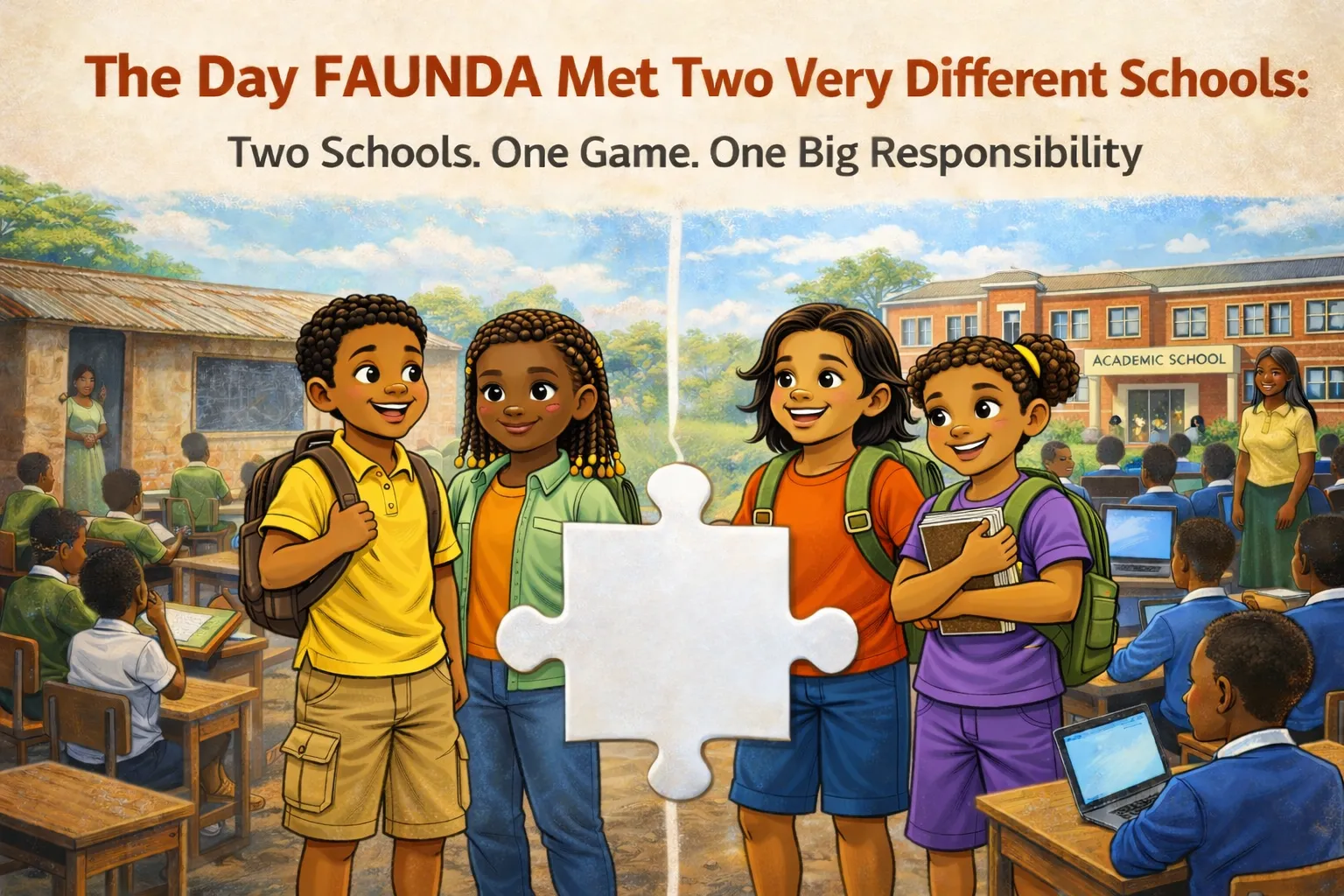
The Day FAUNDA Met Two Very Different Schools
A Story About One Game and a Growing Responsibility
After our first school visits, one thing became clear.
FAUNDA does not live on slides. It does not live in meetings. It lives in classrooms.
So we packed our bags again and went to two more schools. Same game. Same team. Very different realities.
What we learned stayed with us.
The First Welcome
Our first stop was Academic Achievement International School.
From the moment we arrived, the students welcomed us with curiosity and energy. We didn’t start with the game. We started with the FAUNDA companion book.
The students read in turns.
Out loud.
Carefully.
Confidently.
Then we moved to the game.
Twenty-two students.
Four groups.
One shared experience.
And the moment the game began, something familiar happened.
They disappeared into it.
When Engagement Takes Over
As the students played, they stopped listening to us.
Not because they were distracted.
But because they were deeply engaged.
They debated ideas.
They chose problems.
They discussed options.
They laughed.
FAUNDA had their full attention.
So much so that when time ran out for one group, the teacher collected the iPad.
The students immediately asked for it back.
Not to play something else.
To finish FAUNDA.
Other groups finished their games and surprised us again.
They started over.
With new ideas.
New approaches.
New solutions.
They replayed because they wanted to.
What the Students Told Us
When we asked for feedback, they didn’t hesitate.
From the students:
- “It’s educational.”
- “It teaches teamwork.”
- “It’s helpful.”
- “The game is short.”
- “Can we add a timer? Like pressure. A countdown.”
- “After the game is over… what happens next?”
Then they smiled. And played it again.
What the Teachers Told Us
The teachers helped us zoom out.
For FAUNDA to truly work in schools, it needs to connect with what students are already learning.
Their suggestion was clear:
Create versions of the game and book that align with school syllabuses.
That’s how FAUNDA becomes usable. Not just interesting.
The head of the school added another layer.
FAUNDA may need two versions.
One for schools.
One for private use.
Same purpose.
Different needs.
We listened.
A Very Different Classroom
Our next visit took us somewhere very different.
Turiani Secondary School.
A public school. Four groups. Twenty students.
Here, the challenge wasn’t curiosity or effort.
It was language.
Most students were not comfortable with English. Reading took time. Understanding took effort.
At first, progress was slow.
Then we translated the questions.
And something important happened.
They got the answers right.
The thinking was there.
The ideas were there.
The problem was not ability.
It was access.
A Choice We Didn’t Expect
We asked a simple question.
“Would you prefer the game in Swahili?”
They said no.
They wanted to learn English.
That changed our approach.
Instead of replacing English, we decided to support it.
The solution we’re now building is simple but powerful:
A translate button.
Tap to understand.
Tap again to continue learning.
No exclusion.
No shortcuts.
Just support.
One Game. Many Realities.
These two schools taught us something important.
Building FAUNDA is not about making a game that works in one classroom. It’s about building something that respects very different realities.
Private schools.
Public schools.
English-first students.
English-learning students.
Same curiosity.
Same potential.
Different starting points.
And that comes with responsibility.
What We’re Carrying Forward
From these visits, FAUNDA is growing.
We’re thinking more deeply about:
- Replayability
- What happens after the game ends
- Timers and pressure
- Language support without exclusion
- Different versions for different environments
Not because it sounds good on paper. But because students and teachers asked for it.
Why This Story Matters
Every school we visit reminds us of something important.
FAUNDA is no longer just an idea we’re exploring. It’s something others are using.
And once kids put their hands on it.
Once teachers shape it.
Once classrooms influence it.
We don’t get to build casually anymore.
That responsibility is real. And it’s one we’re proud to carry.
Build. Play. Learn.
FAUNDA is growing.